
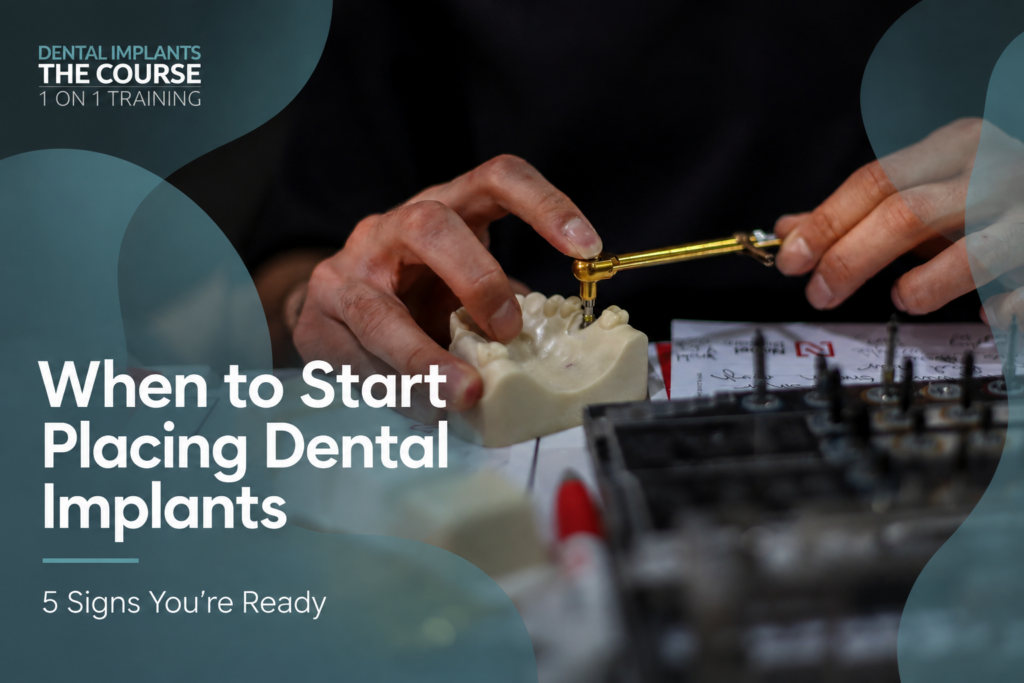
Completing a course or purchasing an implant system does not automatically mean you are ready to begin placing implants independently. At the same time, feeling some uncertainty before your first cases does not necessarily mean you should postpone implant dentistry indefinitely.
The question of when to start placing dental implants should be answered by evaluating your clinical foundation, treatment-planning skills, case-selection judgment, training, equipment, support network, and ability to manage the entire patient journey.
Readiness is not about reaching a specific number of years in practice. It is about knowing which cases match your current level of competence and recognizing when a patient should be referred to a more experienced clinician.
Quick answer: You may be ready to start placing dental implants when you can confidently diagnose and treatment-plan straightforward cases, have completed structured hands-on training, can select appropriate patients, have access to the necessary equipment and support, and know how to prevent, identify, and respond to complications. |
Clinical Expertise and Experience are Key
Of course, the best dental implant instructors have years of professional experience. Practice makes perfect, and if you are learning from someone, it should be an instructor who not only knows what they’re talking about, but also has extensive practical implant experience, not just the theory. Relevant, hands-on training depends on real-world clinical experience with complex cases, knowledge of a variety of implant systems, and other critical factors.
How to Know You’re Ready for Implants
For most general dentists, implant readiness develops gradually. It combines knowledge, supervised clinical experience, repetition, and sound judgment.
The following five signs can help you evaluate whether you are prepared to begin incorporating implant placement into your practice.
1. You Have a Strong Foundation in General Dentistry
Successful implant dentistry begins long before the osteotomy. Dentists must understand how the planned implant will integrate with the patient’s periodontal health, occlusion, restorative needs, anatomy, esthetic expectations, and long-term maintenance.
A strong foundation usually includes confidence in:
- Comprehensive diagnosis and treatment planning.
- Reviewing medical and dental histories.
- Periodontal assessment and disease control.
- Restorative and prosthetic planning.
- Basic surgical principles and sterile technique.
- Occlusal evaluation.
- Reading appropriate diagnostic imaging.
- Communicating treatment alternatives and limitations.
Implant placement should be prosthetically driven. In other words, the desired final restoration should help determine the position and angulation of the implant, not the other way around.
If you are still uncomfortable developing a complete restorative plan or identifying factors that may make treatment less predictable, additional education and mentorship should come before independent implant placement.
2. You Can Select Appropriate Cases and Recognize When to Refer
One of the clearest signs of readiness is not simply knowing how to place an implant. It is knowing which implant cases you should place at your current level of experience.
New implant dentists should generally begin with carefully selected, lower-complexity cases that match the procedures covered during their training. The exact characteristics of an appropriate first case will depend on the dentist’s education, supervised experience, local regulations, anatomy, restorative plan, and available support.
Questions to Consider Before Accepting a Case
- Is the patient medically appropriate for the planned procedure?
- Is the anatomy clearly understood through the required diagnostic records?
- Is there a predictable restorative plan?
- Does the case require grafting or additional procedures outside your current skill set?
- Are important anatomical structures involved?
- Can you manage the case if the surgical conditions differ from the original plan?
- Do you have an experienced mentor or specialist available for consultation?
Complex esthetic-zone placements, extensive grafting, full-arch rehabilitation, advanced immediate-placement cases, and patients with significant medical or anatomical risk factors may require additional training or specialist involvement.
Knowing when to refer is not a weakness. It is an essential component of responsible clinical judgment.
Before accepting your first cases, review the common mistakes new implant dentists should avoid, including taking on complicated procedures too early.
3. You Have Completed Structured Training and Have Access to Mentorship
Implant dentistry combines diagnostic, surgical, restorative, and patient-management skills. Reading articles and watching procedural videos can strengthen your theoretical knowledge, but surgical confidence also requires supervised application.
Effective implant training for general dentists should cover more than the mechanical steps of implant placement. A complete learning pathway should address:
- Patient evaluation and case selection.
- Prosthetically driven treatment planning.
- Diagnostic imaging and anatomical assessment.
- Surgical instrumentation and drilling protocols.
- Implant positioning.
- Hard- and soft-tissue considerations.
- Restorative planning.
- Postoperative care and maintenance.
- Prevention and management of complications.
- Criteria for stopping or referring a procedure.
Hands-on experience is especially valuable when it includes direct observation, feedback, correction, and discussion with an experienced instructor.
However, completing a training program should not be treated as the end of your education. The transition into clinical practice is safer when you can continue discussing radiographs, treatment plans, and early cases with a mentor.
Learn more about the value of mentorship in dental implant training and how expert feedback can support better clinical decision-making.
4. Your Practice Has the Necessary Infrastructure and Workflows
Clinical knowledge must be supported by a properly prepared practice. Before deciding when to start placing dental implants, evaluate whether your office can support safe, consistent, and well-documented implant care.
Depending on the procedures you intend to perform, preparation may include:
- Access to appropriate 2D and 3D diagnostic imaging.
- An implant motor, surgical handpiece, and compatible surgical kit.
- A reliable implant system and restorative components.
- Appropriate surgical instrumentation and disposables.
- Effective sterilization and infection-control protocols.
- A trained dental assistant familiar with implant procedures.
- Emergency equipment and response protocols.
- Standardized consent and documentation processes.
- Postoperative instructions and follow-up scheduling.
- A system for tracking implant components and patient records.
- A referral network for complex surgical or restorative needs.
You do not necessarily need to own every piece of technology before treating a case. Depending on local requirements and your workflow, some services may be accessed through imaging centers, laboratories, specialists, or other clinical partners.
Technology, however, cannot compensate for incomplete diagnosis or inadequate training. Equipment should support sound clinical judgment not replace it.
5. You Can Manage the Entire Patient Experience
Placing an implant is only one stage of implant treatment. Dentists must also be ready to guide the patient through evaluation, informed consent, surgery, healing, restoration, maintenance, and the management of unexpected findings.
Before incorporating implant placement into your practice, you should be able to clearly discuss:
- The proposed treatment and its objectives.
- Reasonable alternatives, including referral.
- Potential risks and limitations.
- The expected sequence of care.
- The role of healing and follow-up appointments.
- Patient responsibilities before and after surgery.
- Possible changes to the treatment plan.
- Long-term hygiene and maintenance.
You should also have a defined plan for situations that exceed your experience. This may include contacting a mentor, referring to an oral surgeon or periodontist, coordinating with a restorative colleague, or stopping the procedure when continuing would not be in the patient’s best interest.
If you are comfortable discussing both the benefits and limitations of treatment, and you have a clear support plan when a case becomes more complicated, you may be approaching the appropriate stage to begin.
Dental Implant Readiness Checklist
Area | Readiness question |
|---|---|
Diagnosis | Can I identify the medical, periodontal, anatomical, occlusal, and restorative factors that affect this case? |
Treatment planning | Can I plan the implant according to the desired final restoration? |
Case selection | Can I explain why this case is appropriate for my current experience? |
Training | Have I completed structured education that includes supervised practical experience? |
Mentorship | Can I obtain experienced guidance before, during, or after my early cases? |
Equipment | Does my practice have access to the required imaging, instruments, materials, and emergency systems? |
Team preparation | Does my team understand surgical setup, sterilization, documentation, and postoperative workflows? |
Patient communication | Can I clearly explain alternatives, risks, expectations, maintenance, and referral options? |
Professional scope | Does the procedure comply with my license, training, insurance requirements, and local regulations? |
If several of these questions produce an uncertain answer, the next step is not necessarily to abandon implant dentistry. Instead, identify the specific gaps that should be addressed before treating an independent case.
What to Do If You Are Almost Ready
Many dentists understand the theory of implant placement but need additional experience before applying it confidently in practice. In that situation, focus on building a gradual and structured transition.
Strengthen Treatment Planning
Review cases with experienced implant dentists and practice developing complete surgical and restorative plans. Treatment-planning exercises can reveal knowledge gaps before they affect a patient.
Gain Supervised Clinical Experience
Choose training that provides direct feedback and practical application rather than relying entirely on lectures. Explore the structure of our hands-on dental implant training program.
Build a Mentorship and Referral Network
Identify specialists and experienced clinicians who can review cases, answer questions, or accept referrals when treatment exceeds your current scope.
Create Standardized Workflows
Develop checklists for records, surgical setup, consent, postoperative instructions, follow-up, restorative coordination, and component tracking.
Begin with Procedures That Match Your Training
Avoid allowing patient pressure, financial motivation, or competition with other practices to determine case selection. Expand your services only as your clinical competence and support systems develop.
Starting Implant Dentistry as a GP: Progress in Stages
Starting implant dentistry as a GP does not require moving immediately from basic education to advanced procedures. A progressive pathway may include:
- Developing a strong foundation in implant diagnosis and restorative planning.
- Reviewing cases with experienced implant clinicians.
- Observing and participating in supervised procedures.
- Completing straightforward placements under direct guidance.
- Selecting carefully screened early cases for your practice.
- Continuing to review outcomes with a mentor.
- Adding more complex procedures only after demonstrating consistent proficiency.
This staged approach allows your clinical judgment, surgical skills, team systems, and confidence to develop together.
Frequently Asked Questions
Can a general dentist place dental implants?
General dentists may be able to place dental implants depending on their education, competence, professional license, insurance coverage, and the regulations that apply where they practice. Each dentist should confirm the relevant clinical and legal requirements before offering implant surgery.
How much training is required before placing an implant?
There is no single number of course hours or supervised implants that guarantees readiness for every dentist. The necessary preparation depends on previous surgical experience, the quality of training, case complexity, mentorship, and the clinician’s demonstrated competence.
What is the best first implant case?
There is no universal first case that is appropriate for every dentist. Early cases should be selected with an experienced mentor and should match the dentist’s training, diagnostic abilities, surgical skills, restorative plan, and available support.
Is an online implant course enough to begin placing implants?
Online education can be valuable for learning theory, reviewing treatment planning, and preparing for practical training. However, it does not reproduce the tactile, anatomical, and decision-making experience of performing a supervised clinical procedure.
How do I know I’m ready for implants?
When considering how to know you’re ready for implants, evaluate more than your confidence. You should be able to diagnose and treatment-plan the case, explain why it fits your current competence, perform the procedure using an appropriate protocol, communicate with the patient, and obtain help or refer when necessary.
When Should You Take the Next Step?
The decision about when to start placing dental implants should not be based only on demand, competition, or the completion of a single course. It should be based on the alignment of clinical knowledge, supervised experience, case-selection judgment, practice preparation, and professional support.
If you have a solid foundation but need supervised practical experience, Dental Implants: The Course offers dental implant continuing education in Guadalajara, Mexico, led by U.S. and internationally trained specialists.
Explore our individualized implant training experience, review the upcoming dental implant courses, or contact our team to discuss the training level that best matches your current experience and clinical goals.
This content is intended for dental professionals for general educational purposes. It does not replace individualized clinical judgment, professional training, legal advice, or the regulations and standards applicable in the clinician’s jurisdiction.