
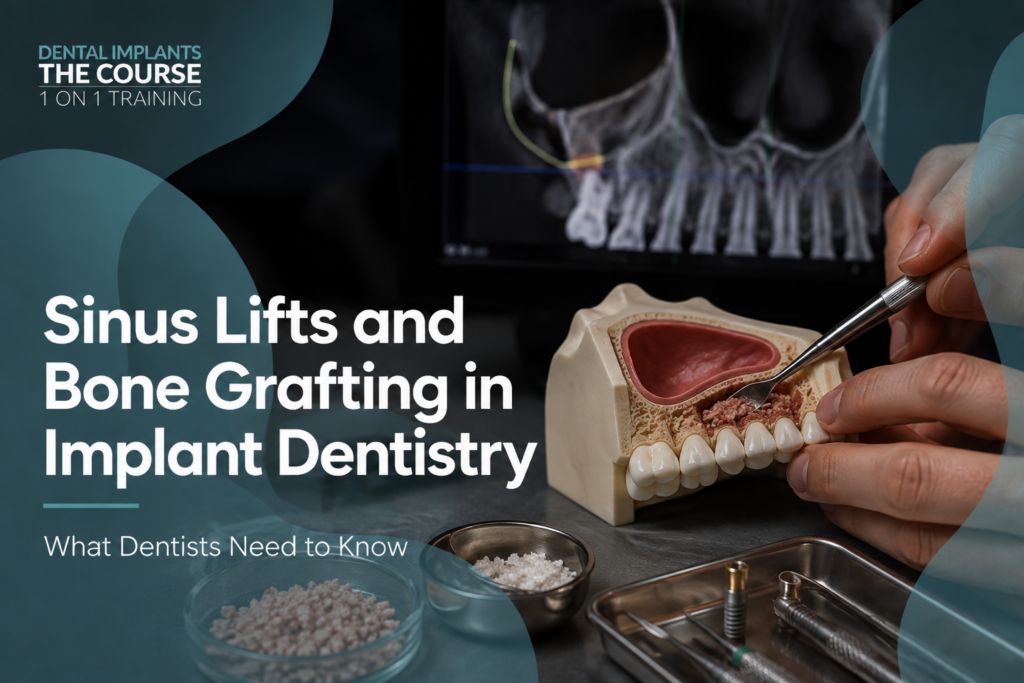
Implant placement depends on having an appropriate hard-tissue foundation. When ridge dimensions are inadequate or the maxillary sinus limits available bone in the posterior maxilla, augmentation procedures may become part of the treatment plan. For dentists who want to treat a broader range of implant cases, sinus lift and bone grafting training can therefore become an important next stage of continuing education.
These procedures should not be learned as isolated surgical techniques. Good training begins with diagnosis and case selection: understanding why augmentation is needed, which approach fits the anatomy and restorative objective, what imaging is required, and when the case exceeds the clinician’s current experience.
This guide explains the clinical concepts dentists should understand before pursuing more advanced grafting education and what to look for in a hands-on training program.
Quick answer: Sinus lift and bone grafting training should teach dentists how to evaluate bone volume and anatomy, select appropriate patients and techniques, plan with suitable imaging, handle grafting materials and tissues under supervision, recognize complications, and know when to refer. The goal is not simply to perform a graft, but to create a predictable implant site within a complete restorative plan. |
Why Bone Grafting Is Important for Implants
A dental implant needs adequate bone volume and a biologically appropriate site for placement and healing. After tooth loss, trauma, periodontal disease, extraction-related remodeling, or long periods of edentulism, the ridge may not provide enough height or width for the planned implant position.
This is the central answer to why bone grafting is important for implants: augmentation can be used to develop or preserve a site when existing anatomy would otherwise compromise implant positioning or the restorative plan.
The objective is not to graft every deficient site. Instead, the clinician should determine whether augmentation is indicated, which technique is appropriate, whether implant placement can occur at the same appointment, and whether the case should be referred to a more experienced surgeon.
When Do Patients Need a Bone Graft?
Not every implant patient requires grafting. The decision depends on clinical examination, the restorative plan, the three-dimensional anatomy of the ridge, soft-tissue conditions, systemic and local risk factors, and the procedure being considered.
Common situations that may prompt an augmentation assessment include:
Long-Standing Tooth Loss
The alveolar ridge remodels after tooth extraction. When a site has been edentulous for an extended period, available ridge dimensions may be reduced, which can affect implant positioning and may create a need for site development.
Periodontal Bone Loss
Periodontal disease can result in significant loss of supporting bone. Before implant treatment, active disease must be addressed and the remaining hard- and soft-tissue architecture evaluated as part of the overall treatment plan.
Extraction Defects or Traumatic Bone Loss
Some extraction sites or traumatic defects have missing facial, lingual, or interproximal bone that may affect ideal implant placement. Ridge preservation or augmentation may be considered depending on the defect and restorative objective.
Limited Posterior Maxillary Bone Height
In the posterior maxilla, sinus anatomy and post-extraction remodeling can limit the vertical bone available for implant placement. In selected cases, sinus floor elevation may be considered to create additional bone volume at the planned implant site.
Developmental or Anatomical Ridge Deficiency
Some patients have ridge anatomy that is naturally narrow or otherwise unfavorable for the intended restoration. These cases require careful three-dimensional evaluation rather than an assumption that grafting is automatically necessary.
How Sinus Lifts and Bone Grafting Are Related
A sinus lift, also called sinus floor elevation or sinus augmentation, is a form of site-development surgery used in the posterior maxilla. The objective is to elevate the sinus membrane and create space for grafted or regenerated bone in an area where vertical bone height is limited.
Bone grafting is a broader category. It can include socket preservation, guided bone regeneration, ridge augmentation, block grafting, particulate grafting, and sinus augmentation. For this reason, dentists taking an advanced course should understand both the common principles shared by grafting procedures and the anatomical considerations specific to the maxillary sinus.
Techniques Dentists May Encounter in Advanced Grafting Training
Technique | Typical purpose | Training emphasis |
|---|---|---|
Socket preservation / ridge preservation | Limit post-extraction ridge changes and support future implant planning | Atraumatic extraction concepts, defect assessment, graft and membrane handling, closure and follow-up |
Guided bone regeneration / ridge augmentation | Develop ridge width or contour where available bone is inadequate for the restorative plan | Defect classification, flap and soft-tissue management, graft containment, membrane principles, tension-free closure |
Intercrestal / transcrestal sinus lift | Elevate the sinus floor through the implant osteotomy in selected posterior maxillary cases | Case selection, imaging, sinus anatomy, membrane protection, controlled instrumentation and implant timing |
Lateral window sinus augmentation | Access the sinus through a lateral approach when more extensive vertical augmentation is required | Advanced anatomy, flap design, membrane elevation, graft management, complication recognition and postoperative care |
Block grafting / advanced augmentation | Reconstruct more substantial ridge deficiencies in selected cases | Donor/recipient site planning, fixation concepts, soft-tissue closure and advanced complication management |
Technique selection is patient- and case-specific. A training program should teach the indications and limitations of each approach rather than presenting one technique as universally preferable.
Why Sinus Lift and Bone Grafting Training Requires Hands-On Experience
Advanced grafting procedures depend heavily on tissue handling, visibility, access, instrumentation, and the clinician’s ability to interpret anatomy while working in a confined surgical field. These are difficult to develop through lectures alone.
Supervised hands-on training gives dentists an opportunity to connect preoperative imaging with actual anatomy, practice surgical workflow, and receive real-time feedback. That is particularly important for procedures in which membrane management, soft-tissue closure, and complication recognition can influence the outcome.
The Dental Implants: The Course program information currently lists intercrestal sinus lifts among intermediate procedures and lateral sinus windows, ridge augmentation, titanium mesh, and block grafting within its advanced bone-grafting level. This progression reflects the different experience required for more complex augmentation procedures.
What High-Quality Sinus Lift and Bone Grafting Training Should Cover
- Diagnosis and restorative-driven case selection.
- Review of medical history and patient-specific risk factors.
- CBCT-based assessment of sinus anatomy, ridge dimensions, and nearby anatomical structures when indicated.
- Recognition of sinus pathology or findings that may require additional evaluation before surgery.
- Selection between less invasive and more advanced augmentation approaches.
- Graft materials, membranes, and biologic principles.
- Soft-tissue management and wound closure concepts.
- Implant timing: staged versus simultaneous placement based on the individual case.
- Prevention, recognition, and management of complications.
- Postoperative evaluation and criteria for referral.
- Supervised clinical practice matched to the participant’s experience.
What High-Quality Sinus Lift and Bone Grafting Training Should Cover
One weakness in the original version of this topic is the idea that a simple X-ray can easily determine whether grafting is needed. In advanced implant planning, two-dimensional imaging may provide useful information, but it does not show the full three-dimensional anatomy of the ridge or maxillary sinus.
For many sinus and augmentation cases, CBCT can provide information about residual bone, sinus morphology, septa, ridge width, neighboring structures, and other anatomical factors that may influence treatment planning. Imaging should always be interpreted together with the clinical examination and restorative objective.
A strong course should therefore teach dentists how to connect imaging findings with case selection rather than treating CBCT as a technology step separate from surgical planning.
Complication Awareness Is Part of Advanced Training
Advanced surgical education should include what can go wrong and how the operator should respond. Depending on the procedure, relevant complications can include sinus membrane perforation, bleeding, infection, wound dehiscence, graft exposure or loss, sinus-related symptoms, poor primary stability, and failure to achieve the planned augmentation.
The educational goal is not to suggest that every complication should be managed by every dentist. Training should help clinicians recognize a problem early, understand immediate priorities, and know when specialist referral or additional medical or dental evaluation is appropriate.
How to Evaluate the Best Courses for Sinus Lift Training
When comparing the best courses for sinus lift training for your needs, start by matching the course to your current surgical experience. A dentist who is still developing confidence with straightforward implant placement should not choose a program solely because it advertises advanced sinus surgery.
- Does the program separate basic, intermediate, and advanced procedures?
- Are participants screened according to previous implant and grafting experience?
- Does training include diagnosis and treatment planning, not only surgery?
- Will you review CBCT imaging and sinus anatomy before the procedure?
- Is there direct chairside supervision from clinicians experienced in grafting and sinus surgery?
- Will you perform procedures, observe them, or assist?
- Are complication prevention and management incorporated into the curriculum?
- Are cases and patients selected to match the operator’s level?
- Is there a path to continue from less complex augmentation to advanced grafting?
For a closer look at the learning model, review the individualized in-person course experience and the current course schedule.
Frequently Asked Questions
When do patients need a bone graft before dental implants?
A graft may be considered when the existing ridge does not provide suitable bone volume or contour for the planned implant and restoration. The decision depends on the defect, anatomy, restorative plan, health factors, and treatment approach; not every implant patient requires grafting.
Is a sinus lift the same as a bone graft?
A sinus lift is one type of augmentation procedure used in the posterior maxilla. Bone grafting is a broader term that includes several techniques for preserving or rebuilding an implant site.
Can a sinus lift and implant placement be performed at the same time?
In selected cases, simultaneous implant placement may be possible. In other cases, augmentation is staged before implant placement. The decision depends on anatomy, the ability to obtain appropriate implant stability, the extent of augmentation, patient factors, and the clinician’s judgment.
Do dentists need CBCT for sinus lift planning?
Three-dimensional imaging is commonly used in advanced implant planning because it can provide information that conventional two-dimensional radiographs cannot. The appropriate imaging protocol should be determined according to the individual case and applicable professional standards.
What should a sinus lift course include?
Look for structured education in anatomy, imaging, indications, case selection, treatment planning, instrumentation, membrane and graft management, complication recognition, postoperative care, and supervised clinical experience appropriate to your skill level.
Advance Your Implant Skills with Structured Grafting Education
Sinus augmentation and bone grafting can expand the range of implant cases a dentist is prepared to evaluate and treat, but they also increase surgical complexity. The right educational path should be progressive, case-based, and closely supervised.
Dental Implants: The Course offers training from foundational implant procedures through advanced bone-grafting techniques in Guadalajara, Mexico. Review the program levels, see upcoming course dates, or contact the team to discuss the training experience that best matches your current skills.
Editorial note: This article is intended for dental professionals and general educational purposes. Clinical decisions should be based on the individual patient, the clinician’s training and scope of practice, current evidence, manufacturer instructions, and applicable regulations.